Health Researcher

Health Researcher
I love research

Thursday, July 31, 2014

Langkah langkah Penelitian

Bagaimana langkah-langkah seorang peneliti melakukan penelitiannya.
1.Mengidentifikasi, memilih dan merumuskan masalah
Setiap penelitian harus dimulai dengan adanya masalah. Dengan adanya masalah-masalah yang banyak dihadapi seseorang tentunya sebelum meneliti harusnya diidentiikasi terlebih dahulu. Masalah yang sudah teridentiikasi harus dirumuskan secara jelas, karena hal ini merupakan pangkal dari segala aspek penelitian. Perlu diperhatikan syarat-syarat utama didalam merumuskan masalah yaitu :
a.Masalah hendaknya dinyatakan dalam kalimat tanya.
b.Rumusan masalah hendaknya singkat, padat, jelas dan mudah untuk dipahami.
c.Rumusan masalah memberi petunjuk tentang mungkinnya mengumpulkan data untuk menjawab pertanyaan dalam rumusan tersebut.
2.Menyusun Kerangka Pemikiran
Seorang peneliti harus menguasai teori-teori sebagai dasar argumennya dalam menyusun kerangka pemikiran. Dalam kerangka ini dijelaskan secara singkat dari gejala yang menjadi obyek yang diteliti. Dalam penyusunan kerangka pemikiran, pola pikiran logislah yang dipakai, agar dapat meyakinkan sesama peneliti.
3.Merumuskan hipotesis
Hipotesis merupakan jawaban sementara terhadap masalah penelitian. Dalam tahapan ini peneliti haruslah sudah mulai memperoleh jawaban-jawaban sementara untuk memecahkan masalah.
4.Menguji Hipotesis secara empirik
Suatu hipotesis harus diuji berdasarkan data empiris, yaitu berdasarkan apa yang dapat diamati dan dapat diukur. Untuk itu peneliti harus mencari situasi atau lapangan empiris yang memberi data yang diperlukan.
5.Melakukan pembahasan
Setelah data diperoleh, selanjutnya data tersebut dibahas dengan adanya sumber dari dasar teori. Dalam pengolahan data, yang pertama kali dilakukan adalah menguji tingkat validitas dan reliabilitasnya. Menganalisa data yang diperoleh merupakan langkah yang sangat kritik dalam penelitian. Penelitian harus memastikan teknik analisis mana yang akan dipilih.
6.Menarik kesimpulan.
Dari hasil analisa tadi maka dapatlah menarik kesimpulan yang merupakan pemecahan dari masalah tadi. Bukan untuk menambah masalah yang baru lagi.

ENUMERASI


Enumerasi adalah tata cara penomoran butir-butir permasalahan dalam penulisan makalah, skripsi, karya ilmiah, penelitian, dan lain sebagainya.
  1. Macam-Macam Sistem Penomoran
Ada 2 macam tata cara penomoran dalam penulisan karya ilmiah ataupun penulisan skripsi :
  1. Sistem balok angka penuh
    1. Angka romawi untuk judul bab
    2. Angka latin untuk judul sub-bab, dan seterusnya
Contoh format sistem penomoran balok angka penuh :
BAB I  {Judul Bab}
 1.1             ……
 1.2             ……
   1.2.1       ……
   1.2.2       ……
 1.3             ……
 1.4             ……
dst.
BAB II
 2.1
 2.2
   2.2.1
   2.2.2
   2.2.3
 2.3
dst.
  1. Sistem campuran angka dan huruf 
Sistem penomoran dengan cara ini menggunakan campuran huruf dan angka dalam formatnya. Contoh format :

BAB I
  1. A.
            1.
                            a.
                                  1)
                                    a)
    B.
            1.
            2.
                            a.
                                 1)
                                   a)
                                   b)
    dst.
 Sistem penomoran mana yang akan dipakai, itu terserah penulis tersebut. Namun dalam penulisan karya ilmiah ataupun skripsi lebih baik menggunakan system penomoran dengan format decimal (angka penuh). Hal ini dimaksudkan agar setiap sub-bab dan sub-judul akan mudah dikoreksi.
 Format Struktur Pengkodean
Pengkodean bab serta bagian-bagiannya dalam Penulisan Skripsi, Makalah serta Karya Ilmiah lainnya dilakukan dengan Format dan teknik sebagai berikut :
  1. Format Penulisan Angka Romawi Besar untuk bab secara berurutan, contoh : I, II, III, dst.
  2. Sistematika Penulisan Huruf Latin Besar untuk sub bab secara alphabetis, contoh : A, B, C, dst.
  3. Cara Penulisan Huruf Arab untuk paragraf secara berurutan, contoh : 1, 2, 3, dst.
  4. Penulisan Huruf Latin Kecil untuk sub paragraf secara Alphabetis, contoh: a, b, c, dst.
  5. Format Penulisan Huruf Arab dengan tanda kurung tutup untuk pasal secara berurutan, contoh : 1), 2), 3), dst.
  6. Penulisan Huruf Latin Kecil dengan tanda kurung tutup untuk sub pasal secara berurutan, contoh : a), b), c), dst.
  7. Penulisan Huruf Arab dengan tanda kurung ( ) untuk ayat secara berurutan, contoh : (1), (2), dst.
  8. Penulisan Huruf Latin Kecil dengan tanda kurung ( ) untuk sub ayat secara berurutan, contoh : (a), (b), (c), dst.
Penyusunan bagian bab dilakukan secara sederhana sehingga keserasian dan keseimbangan dapat dipertahankan.
 Penomoran Halaman
  1. Bagian pendahuluan yang meliputi : halaman judul, nama penulis, kata pengantar, dan daftar isi memakai angka romawi kecil dan diketik di sebelah kanan bawah (i, ii, iii, iv, dst)
  2. Bagian tubuh / pokok bagian dengan angka arab (1,2,3,4 dst) dan diketik dengan jarak 3 cm dari tepi kanan dan 1,5 cm dari tepi atas
  3. Nomor halaman pertama dari tiap bab tidak ditulis tetapi tetap diperhitungkan.
Pada sumber lain, kami juga menemukan berbagai ketentuan-ketentuan dalam penomoran halaman, seperti halaman awal, halaman judul bab, halaman teks utama, dan lain sebagainya, adalah sebagai bertikut :
  1. Bagian awal karya ilmiah (halaman judul, halaman pengesahan, halaman pernyataan, abstrak, riwayat hidup, kata pengantar, daftar isi, daftar table, daftar gambar, dan daftar lampiran) diberi nomor halaman dengan menggunakan angka romawi kecil (I, ii, iii, iv, v, dst) dan ditempatkan ditengah bagian bawah. Halaman judul tidak diberi nomor, tetapi tetap dihitung.
  2. Mulai dari BAB I sampai dengan halamn terakhir pada daftar pustaka diberi nomor halaman dengan angka arab (1, 2, 3, 4 dst). Nomor halaman ditempatkan di sebelah kanan atas, kecuali bab baru yang tidak diisi nomor halaman.
  3. Data yang mendukung penelitian disajikan dalam lampiran yang disajikan menurut kelompoknya tapi tanpa diberi nomor halaman, conto :
Lampiran 1. Pedoman wawancara
Lampiran 2. Peta Desa Sidorejo
 Ihwal Teknik Penulisan Karya Ilmiah
  1. Penomoran
Dalam memberikan nomor, harus diperhatikan hal-hal berikut.
  1. Romawi kecil
Penomoran dengan angka romawi kecil dipakai untuk halaman judul, abstrak, kata pengantar, daftar isi, daftar table, daftar gambar/grafik, serta daftar singkatan dan lambing.
  1. Romawi besar
Angka romawi besar digunakan untuk menomori tajuk bab (bab pendahuluan, bab teoretis, bab metode dan penelitian, bab analisis data, dan bab penutup).
  1. Penomoran dengan angka arab
Penomoran dengan angka arab (1, 2, 3, dst) dimulai dari bab 1 sampai dengan daftar pustaka (termasuk riwayat hidup dan lampiran).
  1. Letak penomoran
Setiap penomoran yang bertuliskan dengan huruf kapital, nomor halaman diletakkan atau berada ditengah-tengah, sedangkan untuk nomor selanjutnya berada di tepi batas kanan atas.
 Sistem Penomoran
Sistem penomoran dengan angka arab menggunakan sistem digital. Angka terakhir dalam sistem digital tidak diberikan titik, misalnya : 1.1 Latar Belakang, 3.2.2 Peranan Bahasa Pembangunan. Akan tetapi, bila satu angka diberi tanda titik, misalnya 1. Pendahuluan 2. Landasan Teori dan lain-lain (dalam makalah). Apabila ada penomoran sistem digital antara angka arab dan huruf, harus dicantumkan titik, misalnya, 2.1.3.a. Fungsi Koperasi.

Wednesday, July 2, 2014

Tracking Progress Towards Results: The M&E Plan and the ITT

Tracking Progress Towards Results: The M&E Plan and the ITT


MCA-N's Monitoring and Evaluation (M&E) Plan was developed to serve as a tool to plan and manage the process of monitoring, evaluating, and reporting progress towards achieving Compact results. It is used in conjunction with other reporting and management tools such as work plans, procurement plans, and financial plans.

The M&E Plan serves as a guide for programme implementation and management and a communication tool that allows MCA-N and other stakeholders to understand the Compact's objectives and the targets the Programme must achieve. The related Indicator Tracking Table (ITT), which reports on the indicators in the M&E Plan on a quarterly basis, helps document progress made towards those objectives and targets as implementation proceeds and provides data and information to support decisions about programme adjustments.

Planning for Results: Compact Development


In the course of Compact/Programme development, Namibia identified its constraints to development and tailored the MCA-N Programme to address those constraints. This means that the Programme should help unlock the country's development potential – and, from the very beginning, indicators were identified and targets established that would help us assess whether this potential was indeed being unlocked.

Logframe Matrix

What is a Logframe Matrix?

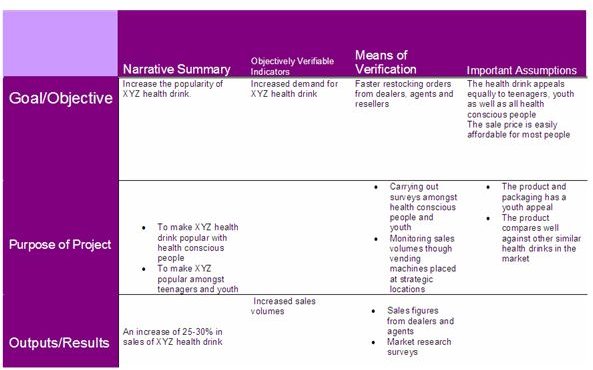
  • A logframe matrix is a short name for a logical framework matrix - a comprehensive project cycle management tool. This tool requires a detailed planning procedure to address problems, identify success criteria and enlist assumptions for the project. At the time of making, a logframe matrix taking the viewpoints of all stakeholders into consideration is a must - to ensure a high level of objectivity.
    Talking about its structure, as can be seen in the example of the logframe matrix, the matrix requires information to be fed into the 16 cross reference cells of the 4x4 matrix. The next section talks more about what goes into each of these cells.
  • Preparing a Logframe Matrix

    Here is more on the information required for making the logical framework matrix:

    Narrative Summary: This column is meant for a short descriptive summary of the project.
    • Goal/Objective: A statement or two about the main goal or objective that the project intends to achieve.
    • Purpose of Project: A list of the main purposes that the project will achieve. This list tries to break down the main goal into smaller achievable goals. For instance as in the example logframe matrix that we have used, the main goal of increasing the popularity of the XYZ health drink has been split into more achievable goals like promoting the product amongst health conscious people, youth and teenagers. Since the same promotion strategy cannot work equally well for all these different An Example of a Logframe Matrix.bmpsegments, it is advisable to split the main goal into sub-goals which seem more achievable.
    • Outputs: This is where the outcome or the end result of the project should be mentioned.
    • Activities: A list of all the strategies and activities that will be used to accomplish the goals and make the above mentioned outputs a reality. In the provided example there are three different strategies that have been identified to help with achieving the goals.

    Objectively Verifiable Indicators: These are measures that will help in assessing the extent to which the objectives have been achieved. The most important requirement here is that these measures should be objective and completely unbiased. Here’s what goes into this column of the logical framework matrix.
    • Goals: A method to find out the extent to which a goal has been fulfilled. As in the example the increases in the demand for the XYZ health drink will help in ascertaining how successful the promotion campaign has been.
    • Purpose: This requires verifiable indicators for each of the purposes on the list.
    • Outputs: Indicators which can be used to determine to what extent the outputs have been achieved.
    • Activities: Indicators to determine whether the input activities have been successful and to what extent.
    Screenshot Taken by: Sidharth Thakur
  • Means of Verification: The means of verification column in the logframe matrix defines the exact source of the data that will be used to evaluate and measure performance.
    • Goals: The exact data source that will be used to determine the successful accomplishment of the goal. In the example of a logframe matrix that has been provided with this article the data source for determining the popularity of the product will be the frequency and volumes of the restocking orders received from the sales channels.
    • Purpose: The data source that can be used to determine the achievement for each of the purposes on the list.
    • Outputs: The data sources for measuring the achieved outputs, for instance in our example the outputs can be measured using sales data and data collected through market research.
    • Activities: The source of data that can be used to verify how well each of the activities or inputs have contributed towards the project.

    Assumptions: Conditions or events outside the control of the project team or those that cannot be manipulated should be enlisted in this column. The ability to achieve the goals depends a great deal on these assumptions, since these assumptions have a direct impact on the project.
    • Goal: Conditions or events that can will determine the long-term feasibility of the rime goal of the project. For instance in the example logframe matrix the assumption that the health drink market will continue to be substantial has a major influence on the main goal of increasing the market share of XYZ health drink.
    • Purpose: List of events and conditions that are a prerequisite for achieving the purposes.
    • Output: Factors which are essential to achieving the outputs.
    • Activity: The conditions or factors which the project is assuming will be available for and at the time of executing the activities.

    Often during project execution the main goal or the big picture takes a back seat and the team members are confused about what they’re trying to achieve. Also the team looses sight of what are the risks, assumptions, the desired outputs and the strategic inputs. For all this, the logical framework matrix comes across as an effective technique. And what’s best about this technique is that it delivers excellent result irrespective of the size or type of the project.

Monday, June 30, 2014

What is Monitoring & Evaluation (M&E)?


This section provides a brief introduction to what M&E is, together with a selection of recommended reading and further links to help you get started.

Monitoring

...is the systematic and routine collection of information from projects and programmes for four main purposes:
  • To learn from experiences to improve practices and activities in the future;
  • To have internal and external accountability of the resources used and the results obtained;
  • To take informed decisions on the future of the initiative;
  • To promote empowerment of beneficiaries of the initiative.
Monitoring is a periodically recurring task already beginning in the planning stage of a project or programme. Monitoring allows results, processes and experiences to be documented and used as a basis to steer decision-making and learning processes. Monitoring is checking progress against plans. The data acquired through monitoring is used for evaluation.

Evaluation

...is assessing, as systematically and objectively as possible, a completed project or programme (or a phase of an ongoing project or programme that has been completed). Evaluations appraise data and information that inform strategic decisions, thus improving the project or programme in the future. 

Evaluations should help to draw conclusions about five main aspects of the intervention:
  • relevance
  • effectiveness
  • efficiency
  • impact
  • sustainability
Information gathered in relation to these aspects during the monitoring process provides the basis for the evaluative analysis.

Monitoring & Evaluation

M&E is an embedded concept and constitutive part of every project or programme design (“must be”). M&E is not an imposed control instrument by the donor or an optional accessory (“nice to have”) of any project or programme. M&E is ideally understood as dialogue on development and its progress between all stakeholders.

In general, monitoring is integral to evaluation. During an evaluation, information from previous monitoring processes is used to understand the ways in which the project or programme developed and stimulated change. Monitoring focuses on the measurement of the following aspects of an intervention:
  • On quantity and quality of the implemented activities (outputs: What do we do? How do we manage our activities?)
  • On processes inherent to a project or programme (outcomes: What were the effects /changes that occurred as a result of your intervention?)
  • On processes external to an intervention (impact: Which broader, long-term effects were triggered by the implemented activities in combination with other environmental factors?)
The evaluation process is an analysis or interpretation of the collected data which delves deeper into the relationships between the results of the project/programme, the effects produced by the project/programme and the overall impact of the project/programme.

The Logical Framework Approach (LFA)

The Logical Framework Approach (LFA) is a management tool mainly used for designing, monitoring and evaluatinginternational development projects. It is also widely known as Goal Oriented Project Planning (GOPP) or Objectives Oriented Project Planning (OOPP).


Background
The Logical Framework Approach was developed in 1969 for the U.S. Agency for International Development (USAID), based on a worldwide study performed by a team from Fry Consultants, Inc. headed by Leon J. Rosenberg.Throughout 1970 and 1971, the tool was implemented across 30 countries, under the guidance of Practical Concepts Incorporated (PCI).The method is widely used by bilateral and multilateral donor organizations like AECID, GTZ, Sida, NORAD, DFID,UNDP, EC and the Inter-American Development Bank. Some non-governmental organizations (NGOs) offer training in the method to ground level field staff.
In the 1990s, it was often mandatory for aid organisations to use the method in their project proposals, but its use in recent years has become more optional. Terry Schmidt, who was involved in PCI's worldwide training programs, is now extending its use to the private sector. Dr Robert Madams, from ADH Training & Consulting, has also used a modified version of the method in the corporate sector in a number of countries.
The Logical Framework Approach is sometimes confused with Logical Framework (LF or Logframe). Whereas the Logical Framework Approach is a project design methodology, the LogFrame is a document.

Description

The text below describes the document, not the global methodology of project design. For the brief description of the LFA as a design methodology, see for example the page [1], for the thorough description see for example AusGuideline 3.3 The Logical Framework Approach cited in "External links" section.
The Logical Framework takes the form of a four x four project table. The four rows are used to describe four different types of events that take place as a project is implemented: the project Activities, Outputs, Purpose and Goal (from bottom to top on the left hand side — see EC web site as under external links). The four columns provide different types of information about the events in each row. The first column is used to provide a Narrative description of the event. The second column lists one or more Objectively Verifiable Indicators (OVIs) of these events taking place. The third column describes theMeans of Verification (MoV) where information will be available on the OVIs, and the fourth column lists the Assumptions. Assumptions are external factors that it is believed could influence (positively or negatively) the events described in the narrative column. The list of assumptions should include those factors that potentially impact on the success of the project, but which cannot be directly controlled by the project or program managers. In some cases these may include what could be killer assumptions, which if proved wrong will have major negative consequences for the project. A good project design should be able to substantiate its assumptions, especially those with a high potential to have a negative impact.

Temporal logic model

The core of the Logical Framework is the "temporal logic model" that runs through the matrix. This takes the form of a series of connected propositions:
  • If these Activities are implemented, and these Assumptions hold, then these Outputs will be delivered
  • If these Outputs are delivered, and these Assumptions hold, then this Purpose will be achieved.
  • If this Purpose is achieved, and these Assumptions hold, then this Goal will be achieved.
These are viewed as a hierarchy of hypotheses, with the project/program manager sharing responsibility with higher management for the validity of hypotheses beyond the output level. Thus, Rosenberg brought the essence of scientific method to non-scientific endeavors.
The "Assumptions" column is of great importance in clarifying the extent to which project/program objectives depend on external factors, and greatly clarify "force majeure" — of particular interest when the Canadian International Development Agency (CIDA) at least briefly used the LFA as the essence of contracts.
The LFA can also be useful in other contexts, both personal and corporate. When developed within an organization, it can be a means of articulating a common interpretation of the objectives of a project and how they will be achieved. The indicators and means of verification force clarifications as one would for a scientific endeavor: "you haven't defined it until you say how you will measure it." Tracking progress against carefully defined output indicators provides a clear basis for monitoring progress; verifying purpose and goal level progress then simplifies evaluation. Given a well constructed logical framework, an informed skeptic and a project advocate should be able to agree on exactly what the project attempts to accomplish, and how likely it is to succeed—in terms of programmatic (goal-level) as well as project (purpose-level) objective.
One of its purposes/early uses was to identify the span of control of 'project management'. In some countries with less than perfect governance and managerial systems, it became an excuse for failure. Externally sourced technical assistance managers were able to say we have implemented all the activities foreseen and produced the outputs required of us, but because of the sub-optimal systems in the country, which are beyond the control of the project's management we have not achieved the purpose(s) and so the goal has not been attained.